
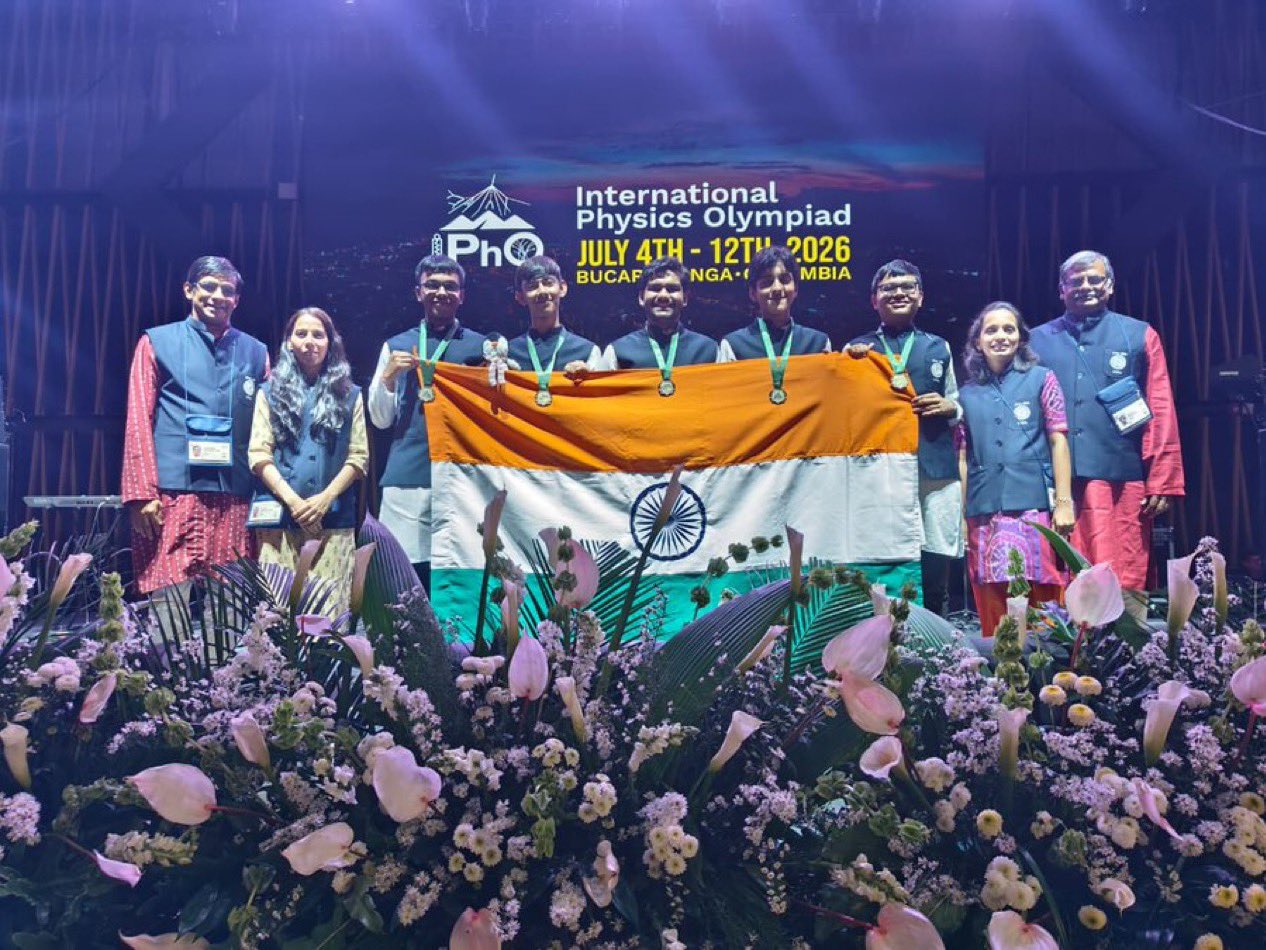
India has achieved a landmark success at the 56th International Physics Olympiad (IPhO) 2026, as all five members of the national team secured Gold medals, placing the country joint first in the world alongside China, Kazakhstan, Russia, South Korea and Taiwan. The competition featured 381 students from 87 countries, making India's clean sweep one of its finest performances in the history of the prestigious global science competition.
The five Indian students who brought glory to the nation are Kanishk Jain (Pune), Riddhesh Anant Bendale (Indore), Rishit Garg (New Delhi), Shresth Suraiya (Mumbai), and Svarit Joshi (Ahmedabad). Their exceptional performances in both theoretical and experimental physics earned each of them a coveted Gold medal.
The International Physics Olympiad is among the world's most challenging competitions for pre-university students, testing participants through demanding examinations that assess conceptual understanding, analytical reasoning and laboratory skills. Achieving a full set of Gold medals reflects the remarkable depth of scientific talent emerging from India.
A significant factor behind India's sustained success in international science Olympiads has been the mentorship and training provided by the Homi Bhabha Centre for Science Education (HBCSE), a centre under the Tata Institute of Fundamental Research. Through a rigorous national selection process and intensive residential training camps, HBCSE prepares India's brightest students to compete with the world's best young scientists.
The achievement is particularly noteworthy because India has produced world-class results without the large-scale, state-funded Olympiad infrastructure available in several other leading nations. Instead, the country's success has been built on the dedication of scientists, teachers, mentors and the extraordinary talent and determination of its students.
The remarkable performance has been widely celebrated across the academic community, with educators and scientists describing it as another milestone in India's growing leadership in science, technology, engineering and mathematics (STEM) education. The victory also reinforces the country's expanding global reputation for nurturing young scientific talent capable of competing at the highest international level.
India's clean sweep at IPhO 2026 is expected to inspire thousands of aspiring students to pursue excellence in physics and scientific research, while highlighting the importance of continued investment in high-quality science education and talent development.