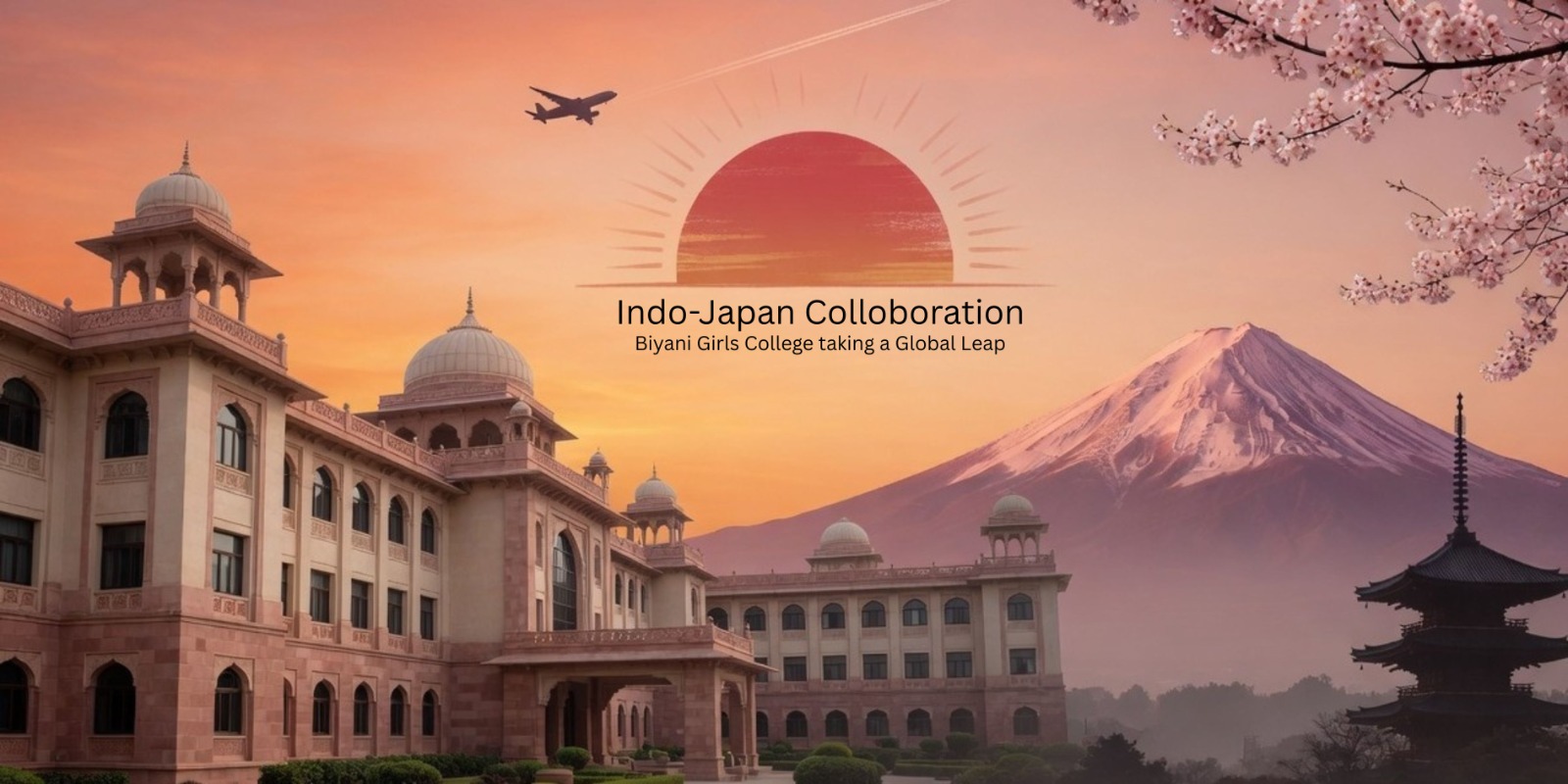
Biyani Girls College, located in the Vidhyadhar Nagar area of Jaipur, has been steadily building one of the more unusual academic relationships in Rajasthan's higher education landscape: a working partnership with research universities in Japan that now extends across faculty exchanges, joint laboratory work and student fieldwork on environmental science.
The most recent chapter unfolded over the summer, when a group of students and faculty from Biyani Girls College travelled to Kwansei Gakuin University in Japan as part of the Sakura Science Exchange Program, an initiative run by the Japan Science and Technology Agency (JST). The programme provided a 15-day immersive academic and cultural experience for the science delegation at Kwansei Gakuin University in July 2025. The students involved were guided by Dr Smriti Tiwari and included Isha Sharma, Aditi, Sakshi, Archana and Saveena, who explored Japan's scientific ecosystem through visits to Daihatsu Motor Co. and Horiba Ltd., conducted clean-air experiments using industrial dust samples brought from Jaipur, and took part in laboratory sessions and molecular studies under Japanese faculty.
The event was not a one-off trip. According to an account published by the Sakura Science Exchange Program itself, the relationship traces back further: in September 2024, six students and their mentor, Dr Smriti Tiwari from Biyani Girls College, visited Japan. BICON is an annual international conference organised by Biyani Girls College. This year too, the visiting Japanese researchers were struck by the scale of the air pollution challenge facing Indian cities, and the conversation that followed shaped the focus of the joint work that came afterward. During the 2025 visit, the Indian delegation joined a laboratory at Kwansei Gakuin University for twelve days, synthesising and evaluating automotive catalysts, and toured Horiba's Shiga facility and Daihatsu's Ikeda plant to observe industrial air-quality practices firsthand.
That laboratory belongs to Professor Hirohisa Tanaka, who heads a research group in the Department of Nanotechnology for Sustainable Energy at Kwansei Gakuin University's School of Science and Technology. His published research areas include self-healing automotive emission control catalysts, hydrogen recombination catalysts that guard against explosions, and fuel cells that generate electricity directly from liquid fuel – work that sits squarely at the intersection of materials science and environmental protection and which now forms the technical backbone of the joint clean-air project with the Jaipur students.
The bridge connecting these two institutions has a long personal history. Dr Manish Biyani, now a full-time professor at Kwansei Gakuin University, has spent close to two decades building his academic career in Japan while remaining closely tied to the Biyani Group of Colleges in Jaipur. After his higher education in Japan, Dr Biyani built a career in bionanotechnology and was invited to join two major national projects of the Japan Science and Technology Agency, CREATE and CREST, for ten years from 2004 to 2013, developing high-speed molecular evolution tools for screening novel biomolecules and biodrugs. He was also appointed Research Assistant Professor in the Department of Bioengineering at the University of Tokyo from 2009 to 2013 before joining the Hokuriku Life Science Cluster project at the Japan Advanced Institute of Science and Technology (JAIST) in 2014, where he was later promoted to research professor. In 2024, he was invited to join Kwansei Gakuin University as a full-time professor to help develop its international master's programme and to promote bilateral ties with India. His current academic output continues to bridge both countries — recent papers on wastewater virus monitoring and SARS-CoV-2 detection methods list collaborators based in both Japan and Biyani institutions in Jaipur.
On the Jaipur side, Dr Sanjay Biyani, Director (Academics) of Biyani Girls College, has long been a connector between the two education systems. He was invited by Saitama University in Japan to study and compare the educational systems and research technologies of India and Japan, an experience he has carried into shaping the college's international outlook over the years. Together with Dr Manish Biyani, he has been part of the founding leadership that established Biyani Shikshan Samiti and steered the institution toward international science partnerships.
Coordinating the day-to-day exchange work is Dr Smriti Tiwari, who serves as Head of Placements and Training at Biyani Girls College and has emerged as the lead faculty coordinator for the Indo-Japan student programmes – the person who has now twice led student cohorts to Japan under the Sakura Science framework and who maintains the working relationship with Professor Tanaka's laboratory.
Guiding the broader research vision is Dr Radhika Biyani, Assistant Director for Research, Development and Global Affairs at Biyani Group of Colleges. Having studied and trained in Japan herself, she has spoken of wanting to extend that "moulding" experience to students at Biyani, combining research-orientated technical education with the interpersonal and professional grooming she encountered abroad — a philosophy that now visibly shapes the structure of these exchange programmes. She has also contributed directly to the underlying science: research listings show her as a co-author on recent molecular diagnostics work alongside Dr Manish Biyani and Japanese collaborators.
The combined effect of these threads — personal histories in Japanese academia, a structured JST-backed exchange pipeline, and joint laboratory work on real-world environmental problems — has given a Jaipur women's college an international research footprint that is unusual for an institution of its size, with faculty and students expected to continue rotating through Kwansei Gakuin University and JAIST laboratories in the coming academic cycles.