On the morning of June 24, 2016, David Cameron walked out of 10 Downing Street, stood before a lectern, and announced he would resign. Britain had voted the night before to leave the European Union — a referendum Cameron himself had called, confident he would win it. He lost. And in losing it, he set in motion something that British politics has not recovered from since.
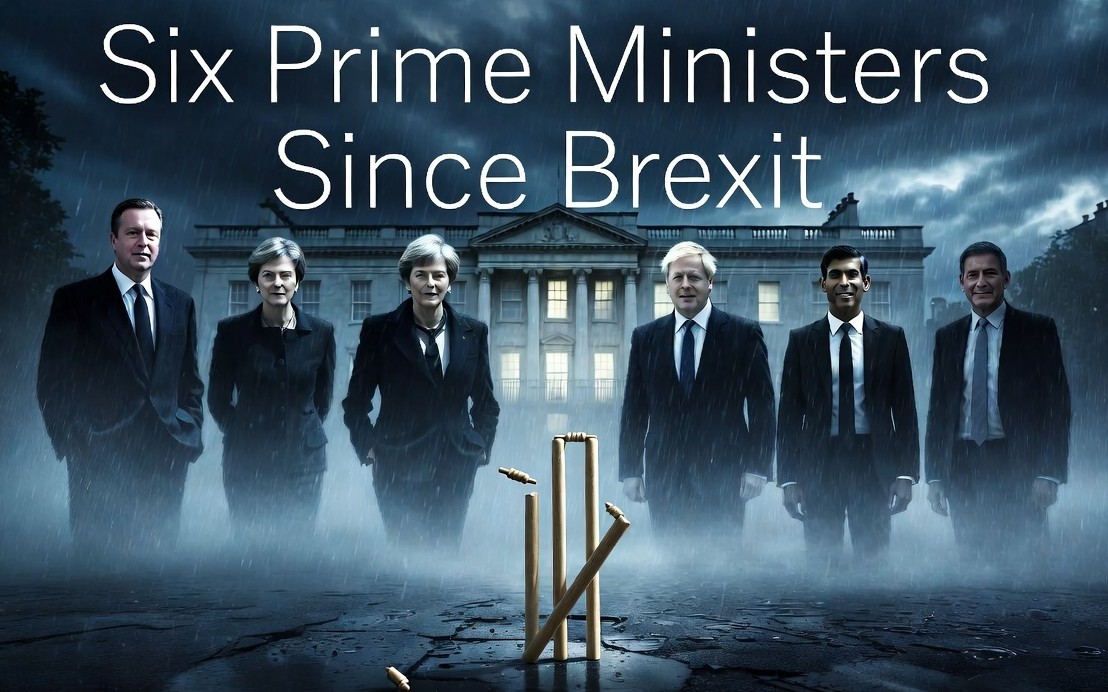
In the decade that followed, five more Prime Ministers have stood at that same spot and delivered their own versions of the same speech. Theresa May. Boris Johnson. Liz Truss. Rishi Sunak. Keir Starmer. Six leaders in ten years, each one brought down by a different proximate cause — a referendum result, a backstop, a party rebellion, a disastrous mini-budget, an election, a by-election — but all of them, in one way or another, navigating the same underlying turbulence that the Brexit vote unleashed and that Britain has yet to fully absorb.
Cameron: The Man Who Lit the Match
Cameron's calculation in calling the referendum was political rather than ideological — a device to silence the Eurosceptic wing of his own Conservative Party and neutralise the threat from Nigel Farage's UKIP. It backfired catastrophically. The morning after the result, he stood outside Number 10 with his wife Samantha, delivered a short, dignified statement, and walked back inside to the strains of a cheerful tune he apparently hummed to himself — a moment that felt almost surreally light given what had just been set in motion. By the end of the year he was gone, replaced by his Home Secretary.
May, Johnson, Truss: A Sticky Wicket That Never Dried Out
Each of the three Prime Ministers who followed Cameron inherited what cricket would call a sticky wicket — a pitch made treacherous not by their own doing but by what the previous occupant had left behind. The particular difficulty of British politics since Brexit is that the pitch never seemed to dry out. Each new batter arrived to find conditions, if anything, worse than before.
Theresa May inherited the most thankless brief in modern British political history: delivering a Brexit that meant different things to different people, negotiating with a European Union that held most of the cards, and holding together a parliamentary party that couldn't agree on what it actually wanted. She tried three times to get her withdrawal agreement through Parliament. Three times it failed. She resigned in tears in May 2019, her voice breaking outside the same door Cameron had walked away from three years earlier.
Boris Johnson arrived with the mandate and the majority May never had. He got Brexit done — or at least a version of it, in a form that satisfied enough people enough of the time to win a thumping election victory in December 2019. But the discipline that getting Brexit done required was not a discipline Johnson was temperamentally built to sustain. A string of scandals — parties held in Downing Street during pandemic lockdowns, misleading statements to Parliament, the handling of a colleague's misconduct — eroded his standing until his own cabinet walked out en masse in July 2022, leaving him no choice but to follow.
What followed Johnson was, by any measure, the most extraordinary episode in modern British economic and political history. Liz Truss arrived in September 2022 with a bold, ideologically driven economic programme — sweeping unfunded tax cuts that the markets, the Bank of England, and eventually her own party decided they could not absorb. The pound crashed. Mortgage rates spiked. Pension funds teetered. Within weeks the flagship policy was reversed. Within 45 days Truss herself was gone, having lasted less time in office than a head of lettuce — a comparison a British tabloid made live on air, and which turned out to be accurate. She remains the shortest-serving Prime Minister in British history.
Sunak: Steadiness After the Storm — and a Milestone That Matters
Into that chaos came Rishi Sunak — and here, for readers of Indian origin and the Indian diaspora worldwide, the story carries a significance that goes well beyond the mechanics of British politics. Sunak became, in October 2022, the first person of Indian heritage ever to lead a G7 nation. The son of a doctor and a pharmacist, both of Punjabi origin, raised in Southampton, educated at Winchester and Oxford, his arrival at Downing Street was a moment that resonated in living rooms from Mumbai to Mississauga in a way that Westminster's commentary struggled to fully capture. It was, whatever one thinks of his politics, a genuine landmark in the long story of the Indian diaspora's journey in Britain.
As Prime Minister, Sunak brought order where Truss had brought chaos. He stabilised the public finances, steadied the markets, and restored a degree of international credibility to an office that had taken a battering. He was respected abroad even when he struggled at home. He lost the 2024 general election heavily — Labour's landslide was one of the largest in modern British history — but he left with his personal standing largely intact, a man who had done a serious job seriously in circumstances that were never easy.
He too had walked onto a sticky wicket. He simply held his ground longer than most expected before the innings ended.
Starmer: The International Statesman Who Couldn't Survive at Home
Keir Starmer arrived with a mandate that dwarfed anything his predecessors had enjoyed since Tony Blair. He inherited, as he himself acknowledged in his resignation speech on Monday, a Labour Party that was "politically, financially and morally bankrupt" — and he rebuilt it, disciplined it, and led it to the kind of victory that just years earlier had been dismissed as impossible. Internationally, he was widely admired: a steady hand on Ukraine, a serious presence on Iran, and a leader the European Commission's Ursula von der Leyen described as having grown into a statesman of genuine stature in just two years.
But domestic politics is domestic politics, and the ground shifted faster than his government could adapt. Local election losses, cabinet resignations, the relentless rise of Reform UK, and ultimately Andy Burnham's commanding by-election victory in Makerfield — which returned a man of enormous personal popularity to Westminster at precisely the moment Starmer was most vulnerable — ended his premiership before it had fully found its feet. He resigned on Monday morning, his voice cracking only when he turned to thank his wife.
As NDD reported, even that moment had been pre-empted — by Donald Trump, who declared on Truth Social the day before that Starmer would resign, before Downing Street had confirmed a word. When a foreign leader can call your Prime Minister's resignation before it happens, from across the Atlantic, something has changed in how the world sees your institutions. NDD's full report on Starmer's resignation covers the farewell speech, the market reaction and the road ahead in Westminster in detail.
The India Dimension: A £48 Billion Question
For India, and for NDD's readers, the timing of Starmer's departure carries a specific and pointed significance that has received little attention in Britain's inward-looking political commentary.
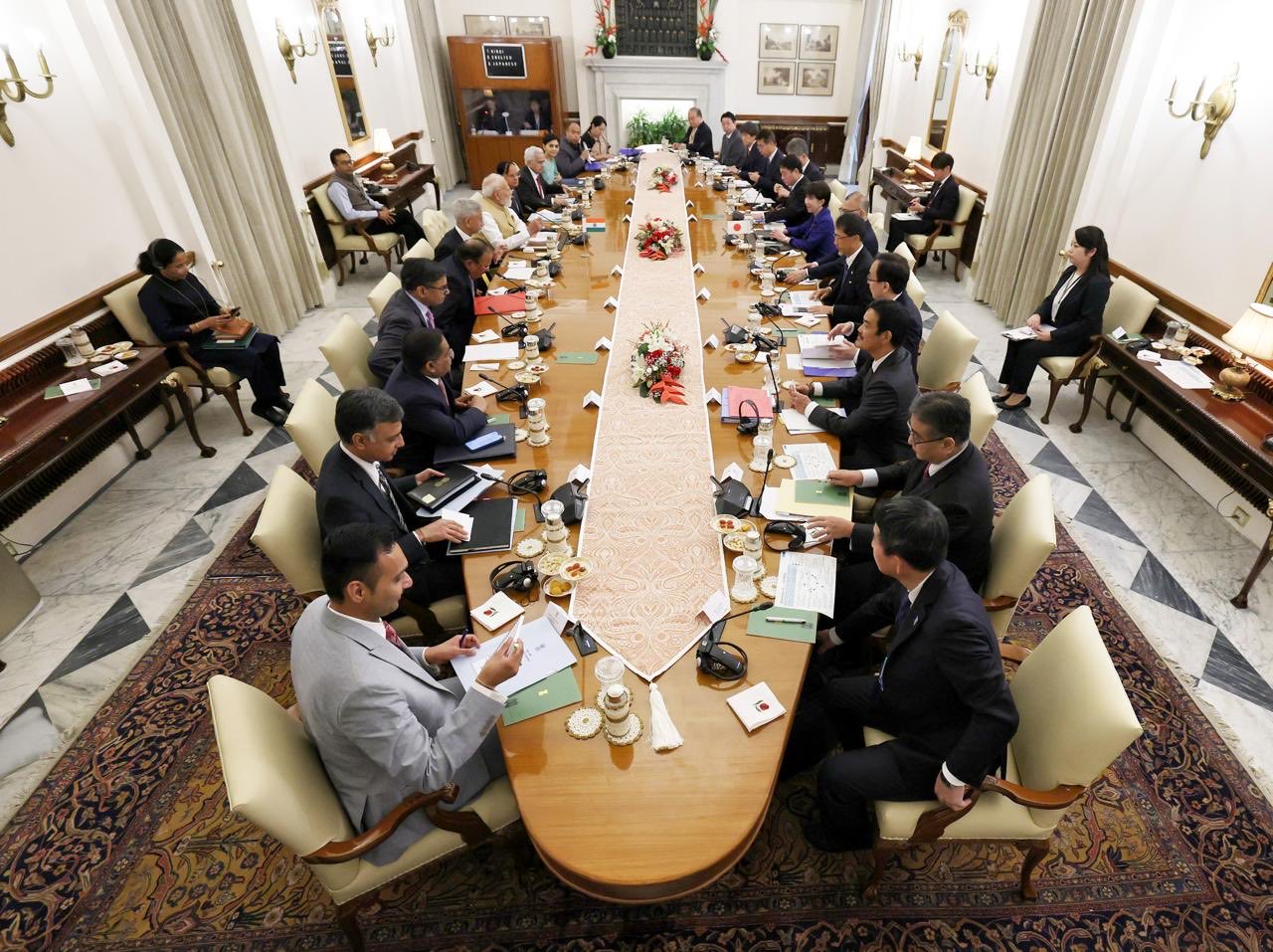
Just days before announcing his resignation, Starmer met Prime Minister Narendra Modi on the sidelines of the G7 summit in France. The two leaders agreed on a date: July 15, 2026 — the day the long-negotiated India-UK Comprehensive Economic and Trade Agreement, known as CETA, would come into force. The deal, years in the making, covers a bilateral trading relationship worth £48 billion and is expected to deliver significant benefits on both sides — easier market access for Indian goods and services, reduced barriers for British businesses, and new pathways for mobility and professional exchange.
Britain will almost certainly have a new Prime Minister by the time that date arrives.
Whether the incoming leader will honour the July 15 date, seek amendments, or use the transition as an opportunity to revisit the terms is a question that New Delhi will be watching with considerable attention. Most analysts believe Britain's political consensus across parties broadly supports closer economic ties with India and that a total reversal is unlikely. But "unlikely" and "certain" are not the same thing, and the India-UK FTA has already survived more political turbulence than almost any comparable trade negotiation in recent memory — outlasting the tenures of May, Johnson, Truss and Sunak, each of whom was in office while the deal was being discussed and debated.
Starmer, as it turns out, was the Prime Minister who got it over the line. The irony is that he may not be the one in office when it comes into force.
Beyond trade, the implications of Britain's leadership churn extend to Indian students — the largest group of international students in UK universities — whose visa conditions and post-study work rights have shifted with almost every change of government since 2016. They extend to the British Indian community, one of the most economically successful and politically engaged diaspora communities in the world, which has now watched six Prime Ministers come and go in the span of a single working life. And they extend to the broader India-UK strategic partnership — in defence technology, cybersecurity, clean energy and the Indo-Pacific — which, while driven by institutional momentum rather than individual leaders, nonetheless benefits from the continuity and trust that revolving-door politics makes harder to build.
A System Under Strain
The deeper question — one that Britain's political class is only beginning to seriously confront — is whether what has happened since 2016 is a temporary correction, a decade-long working-through of the consequences of one traumatic national decision, or whether it reflects something more structurally broken in the Westminster system itself.
No comparable democracy has cycled through its leadership at this pace. Germany has had two chancellors in the same period. France two presidents. India one Prime Minister. The United States two presidents, soon to be three. Britain has had six heads of government in ten years.
Cameron lit the match in June 2016. The pitch has been sticky ever since.