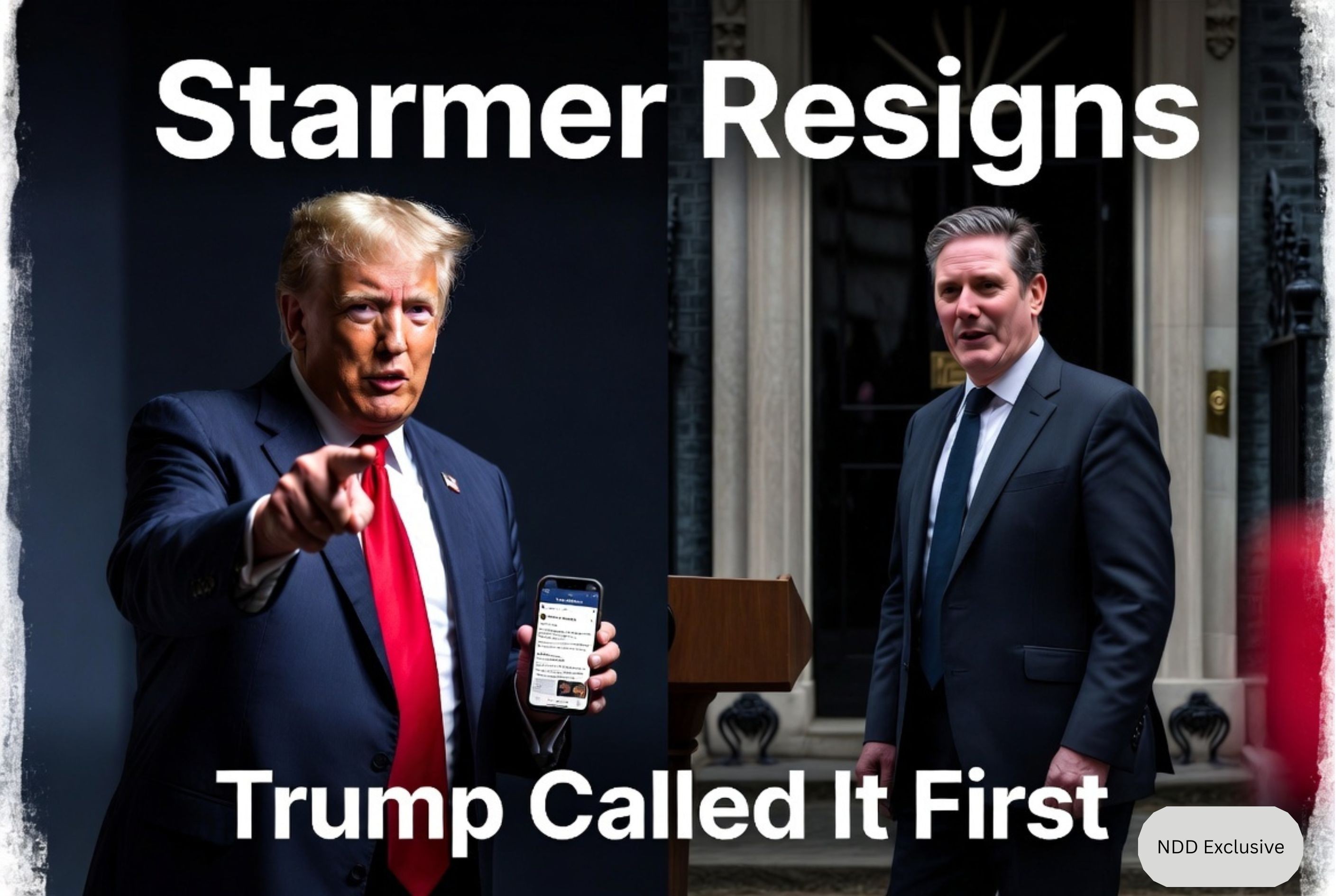
Keir Starmer stood outside 10 Downing Street on Monday morning, looked into the cameras and said words many in his party had been pressing for. He was stepping down — as Labour leader, and as Prime Minister of the United Kingdom.
As NDD reported earlier, President Donald Trump had already declared on Truth Social the previous day that Starmer would resign — a claim Downing Street declined to confirm or deny at the time. By Monday morning, it had come true.
"The Proudest Moment of My Life — and the Hardest"
There was applause from those gathered outside Number 10 as Starmer took to the podium. He began by recalling the morning two years ago when he first walked up that same street as Prime Minister — a new Labour government, the first in fourteen years, a moment he called the proudest of his life. He spoke of what he came into politics for: the chance to change lives, to turn a page after years of what he called "disappointment and despair."
Then came the harder passage. He told the country he had heard the question his party was asking — whether he was the right person to lead Labour into the next general election — and accepted the answer "with good grace." His voice held steady through most of the speech, but cracked when he turned to thank his wife Victoria, who stood nearby and embraced him as he finished. "Every decision I have taken," he said, "has been about putting the country I love first."
He confirmed he had spoken to King Charles earlier that morning. Labour's National Executive Committee would open leadership nominations on July 9, he said, with the process completed before Parliament returns from its summer recess in September. Until then, Starmer said he would remain in post as caretaker Prime Minister and give his successor his "full and unequivocal support," confident they would inherit a Britain he described as stronger and fairer than the one he found.
Domestic Pressures Mount as Starmer Steps Down
The domestic verdict on Starmer was harsh — and to a degree, fair. A disastrous set of local election results in May, in which Labour shed more than a thousand council seats, a succession of cabinet resignations that left him increasingly isolated, and the relentless rise of Nigel Farage's Reform UK all combined to erode a majority that had once seemed unassailable. More than a hundred Labour MPs had publicly called on him to go.
But the international picture told a rather different story. Starmer was widely respected abroad — a calm, serious presence on Ukraine, a steady hand during the Iran crisis, and a leader European Commission President Ursula von der Leyen described on Monday as someone who grew into a statesman of genuine stature in just two years. He inherited a Labour Party he himself described as "politically, financially and morally bankrupt," rebuilt it into a landslide-winning force, and leaves office with his personal dignity intact. History, and those who watched him from outside Britain, may remember him more generously than the domestic political verdict suggests.
He is not the first recent occupant of Number 10 of whom that can be said. Rishi Sunak — who preceded Starmer and holds a significance for Indian and diaspora communities that goes well beyond British politics, as the first person of Indian heritage to lead a G7 nation — similarly brought seriousness and international credibility to an office in crisis, stabilised Britain after the catastrophic 45-day Truss premiership, and left with his reputation largely intact after a heavy election defeat. Both men were serious figures navigating a political system that has made it increasingly difficult for serious figures to survive.
Burnham’s By-Election Win Forces Swift Transition
The proximate cause of Starmer's fall was not a single scandal but a single by-election. When Andy Burnham — the former Mayor of Greater Manchester, hugely popular across the north of England — won the Makerfield seat last Friday with a commanding majority, the argument for Starmer continuing collapsed overnight. Burnham had made little secret of his ambitions. His victory made them a political reality.
By Monday he was on a train to London — television helicopters tracking his journey from Manchester to Euston — before being formally sworn in as MP for Makerfield at Westminster. He confirmed he would stand for the leadership, calling for the transition to be handled in an "orderly and responsible way." Former Health Secretary Wes Streeting, once his most likely rival, promptly withdrew and threw his full support behind Burnham instead. The path to Number 10 for the man from Manchester now looks close to unobstructed.
Pound Stumbles, Then Steadies
Financial markets absorbed the news with notable composure. The pound dropped sharply in early morning trading, briefly slipping to $1.3181 against the dollar and nudging toward its 2026 low of $1.3159, set back in March. But the sell-off was short-lived. By afternoon sterling had recovered, trading slightly positive against the euro and the yen, as investors appeared to welcome the end of a prolonged period of political uncertainty rather than fear what might come next.
Analysts described the reaction as relief rather than panic. One market strategist put it plainly, saying the muted response in sterling said more about how investors had felt about Starmer than about how they felt about Burnham. The FTSE 100 dipped marginally. Government bond yields held broadly flat. Markets are now watching one thing closely: whether Burnham, once in office, will hold firm on fiscal discipline — a reassurance he has already been careful to signal in the days since his Makerfield victory.
The Question Trump's Post Left Hanging
Trump's Truth Social declaration from Sunday — reported by NDD before Downing Street had uttered a word — turned out to be accurate. Whether it reflected genuine advance knowledge or simply a sharp reading of a political situation that was, by that point, already beyond rescue, remains an open question. What is not in question is that within a single week, the American president made pointed public comments about the domestic political fortunes of two of Washington's closest European allies — first claiming Italy's Giorgia Meloni had humiliated herself seeking a photograph at the G7, then pre-announcing Starmer's resignation before it was confirmed. Both proved consequential. Neither has been fully explained.
Starmer remains at Number 10 for now. Britain waits to learn what — and who — comes next.