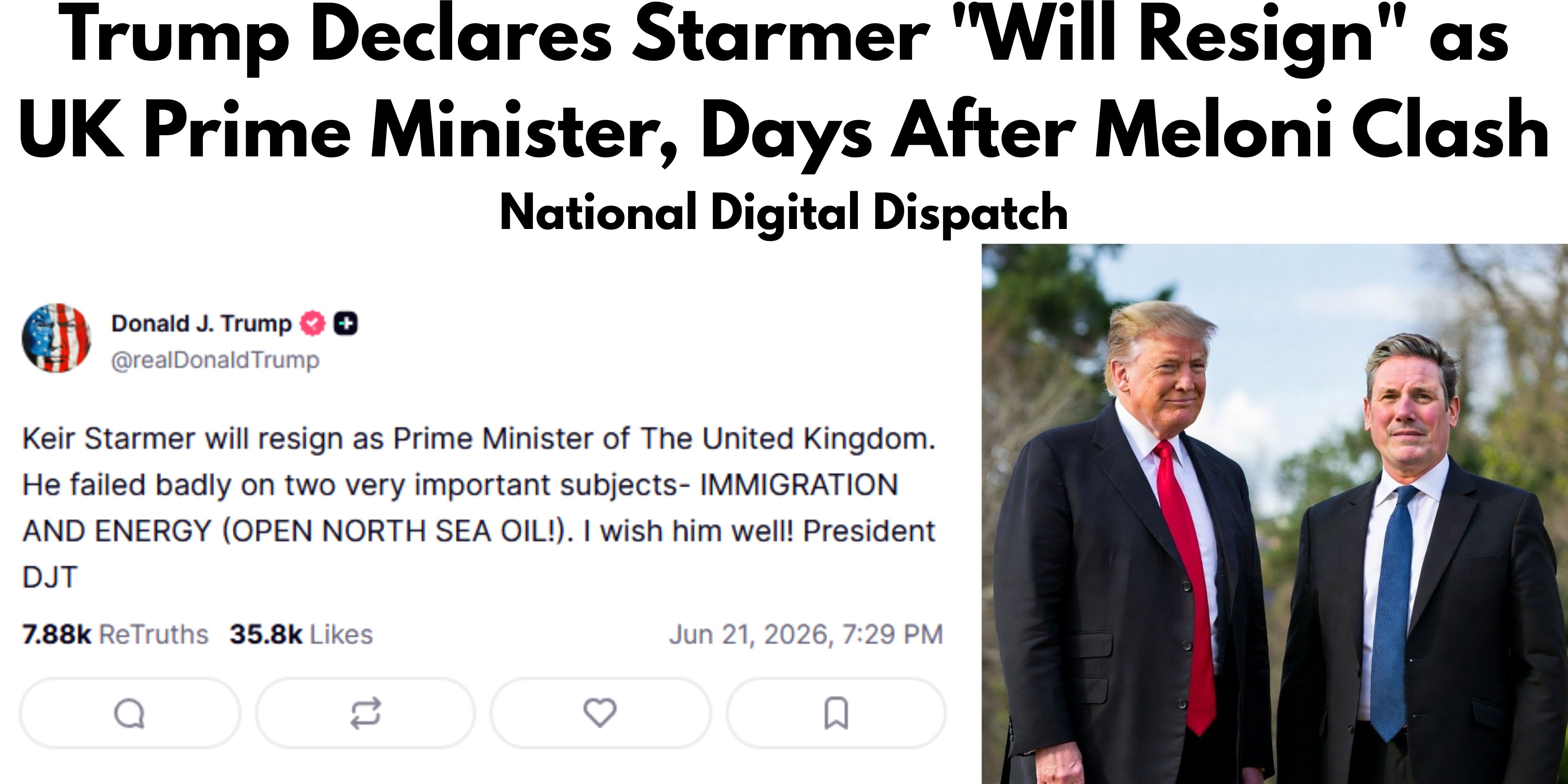
President Donald Trump waded into a deepening political crisis in Westminster on Sunday, declaring that Prime Minister Keir Starmer would step down — even as Downing Street insisted no such decision had actually been announced.
A Pre-Emptive Declaration
Posting on his Truth Social platform, Trump wrote that Starmer would resign, blaming what he called failures on immigration and energy policy, and pointedly calling on Britain to reopen North Sea oil exploration. He closed the post by wishing Starmer well — phrasing that struck many observers as treating the resignation as already settled rather than a matter still playing out behind closed doors in London. Adding to the oddity of the moment, the two leaders are not believed to have spoken directly since crossing paths at the G7 summit in France earlier in the week, raising questions about exactly what, if anything, Trump actually knew before posting.
Downing Street Holds the Line
Pressed on the claim, a spokesperson for the Prime Minister's office declined to confirm or deny it, instead pointing back to remarks Starmer had made just two days earlier, in which he said only that there was more work to do and that serving the country remained his focus. Nothing further was added at the time. Business Secretary Peter Kyle, fielding questions from the BBC the same morning, offered a more telling hint — saying Starmer was weighing up the "political realities" of his position over the weekend and would act in the country's best interest. In Westminster's usual coded language, that kind of phrasing tends to suggest a decision is closer than officials are willing to confirm outright.
Mounting Pressure at Home
Whatever the official line, British newsrooms were already reporting throughout Sunday that an announcement could land as early as Monday, with attention increasingly turning to Andy Burnham — the outgoing Manchester mayor fresh off a by-election win — as the name most often floated as a possible successor. Starmer's position has been weakening for weeks, not months, with disagreements over the war in Iran adding to long-running tension over Britain's energy policy and its refusal to issue new North Sea drilling licences. It's a notable reversal for a leader once nicknamed the "Trump whisperer" for his apparent knack of staying in Washington's good books.
A Pattern Emerging
This isn't the first time in recent days that Trump has spoken publicly about the political fortunes of a fellow G7 leader. Just days earlier, he made headlines for claiming Italian Prime Minister Giorgia Meloni had “begged” him for a photograph at the same summit — a claim Meloni rejected outright and one serious enough that Italy's foreign minister scrapped a planned visit to Washington in response. Seen alongside Sunday's comments about Starmer, a pattern starts to take shape: two allied leaders, within the same week, finding their domestic standing publicly weighed in on by the American president — in one case a photo, in the other an entire premiership. Whether Trump is speaking from genuine insider knowledge or simply offering running commentary on events unfolding outside his own jurisdiction is, in both instances, far from clear.
As of Sunday evening, no resignation had been formally announced in London. The National Digital Dispatch will continue following the story as it develops.