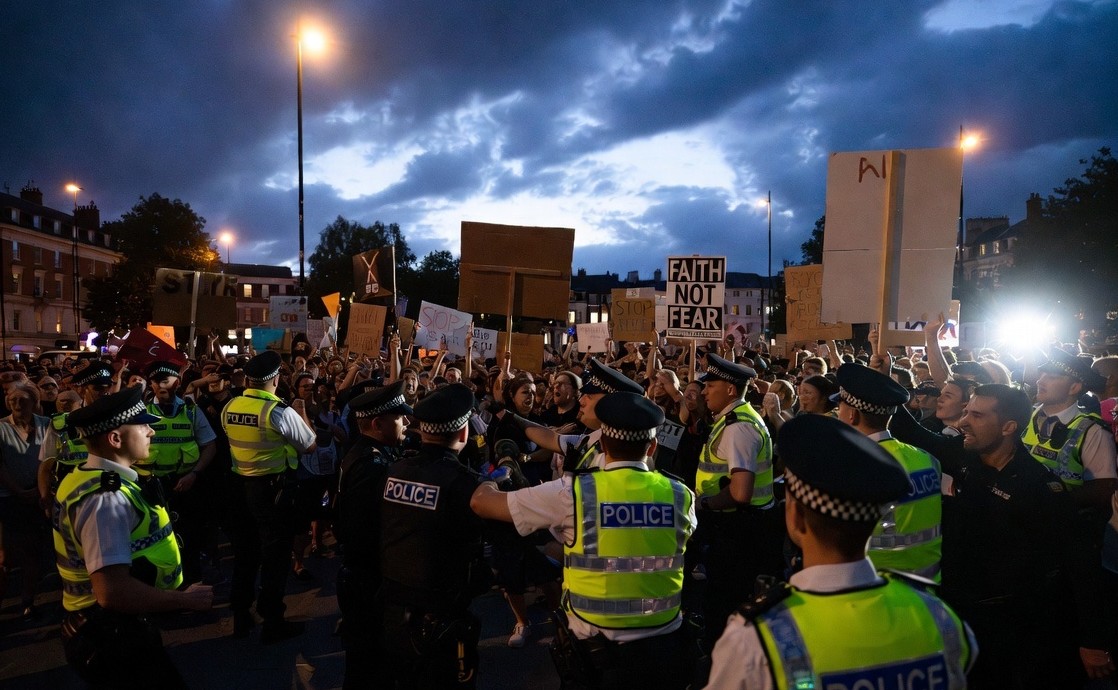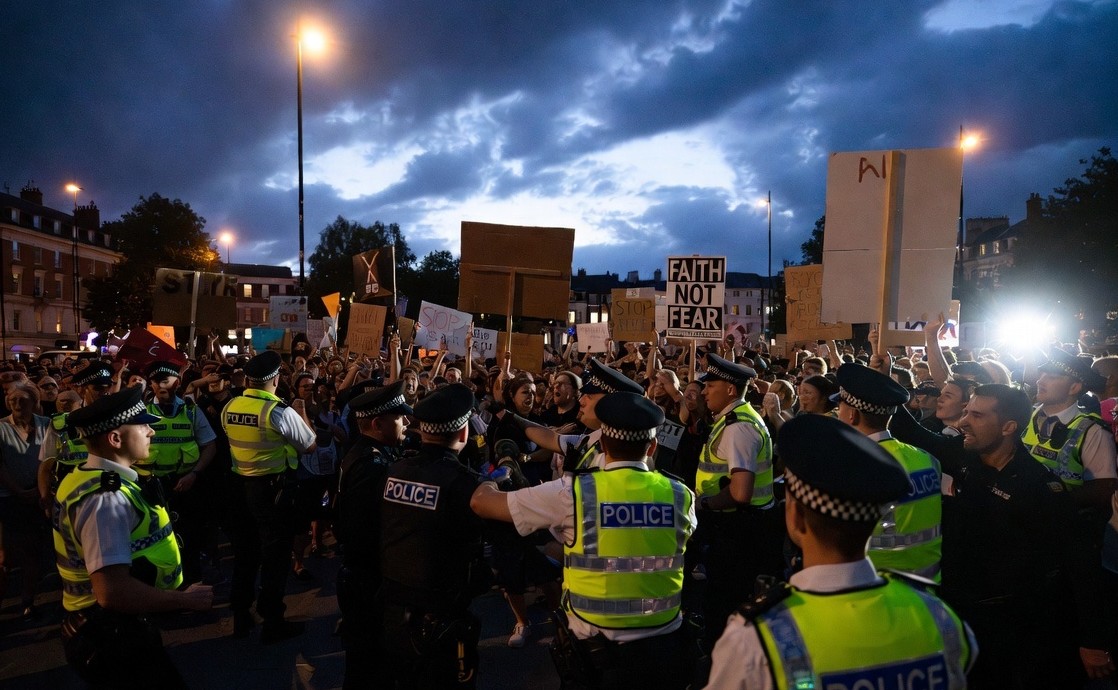
The BBC reporter almost buried the detail. Almost. Amid her dispatch from the Lower Newtownards Road — masked men, bottles, bricks, trash cans being lit like torches — she noted, almost in passing, that the mob had stopped trying to burn one car when a woman rushed out and assured them it belonged to a local. Not a foreigner. So they moved on.
Read that again. A woman in Belfast in 2026 had to stand in the street and vouch for the ethnicity of her car’s owner to save it from fire. And the mob accepted the logic, because the logic — that a foreigner’s property is forfeit — was the entire operating premise of that night.
This is what a pogrom looks like when it happens in a country that publishes an annual human rights report criticising everyone else’s.
The Preacher in the Dock
Every year, Britain’s Foreign, Commonwealth and Development Office releases its Human Rights and Democracy Report — a document that names and shames governments around the world for failing to protect minorities, uphold rule of law, and resist the politics of ethnic scapegoating. The 2025 edition ran to hundreds of pages. It had stern things to say about treatment of minorities in South Asia, Eastern Europe, and the Middle East.
On the night of June 9, 2026, twenty-seven families were driven from their homes in Belfast by mobs going door-to-door trying to identify which houses contained immigrants. Among them: Ugandan carers, a Ukrainian family fleeing one war only to find another, and a Romani family for whom this was, by their neighbours’ account, the third eviction at the hands of their fellow citizens. A two-month-old baby had to be carried out of a burning building.
The fire brigade attended sixty-two incidents in a single night.
If any of this had happened in a country Britain monitors, it would have featured in next year’s report under the heading “ethnic violence” or “racially motivated displacement.” When it happens in Belfast, it gets called “disorder.”
Words matter. Britain has always known this. It simply applies the principle selectively.
Somewhere in Europe, Pope Leo XIV was telling a parliament that borders must be “spaces of protection responsible for human dignity.” Britain’s Home Office was not in the room.
This Was Not a Surprise. That Is the Point.
To treat the Belfast riots as a shock is to have been wilfully inattentive for the past two years.
In June 2025 — twelve months earlier, almost to the day — riots tore through Ballymena after an alleged assault by Romanian-speaking teenagers. By the time the disorder subsided, two-thirds of the town’s Roma population had fled. People with nowhere to go, going anyway, because staying had become more dangerous than leaving.
Before Ballymena, there was Southport in 2024, where three young girls were murdered and the speculation that the killer might be an illegal migrant — he was not — was enough to trigger a national wave of anti-immigrant violence. Mosques were attacked. Hotels housing asylum seekers were surrounded.
The cycle is now established and familiar: a crime involving a foreign national, real or rumoured; a social media ignition, increasingly coordinated; a night or more of targeted violence against immigrant communities; politicians expressing horror; nothing structurally changing; repeat.
What this pattern describes is not a series of isolated incidents. It is a system. And systems have architects.
The Permission Structure
It is tempting — and convenient — to lay the Belfast riots entirely at the feet of Tommy Robinson and Elon Musk. Robinson posted the locations of planned protests within hours of the stabbing. Musk, with two hundred and forty million followers on the platform he owns, amplified it with a call to protest “repeatedly and loudly.” An AI-generated list of businesses told to close by five-thirty in the afternoon circulated on WhatsApp. The machinery of incitement was visible, traceable, and fast.
But to stop the analysis there is to let fifteen years of mainstream British politics off the hook.
The language of “invasion,” of immigration as an existential threat, of asylum seekers as a burden or a danger — this did not originate with the far right. It was road-tested in manifesto pledges, red-topped newspaper front pages, and Home Office press releases. Successive governments promised to reduce net migration to the tens of thousands, failed, and responded to that failure not by moderating the promise but by intensifying the rhetoric. What the far right did was take that rhetoric to its logical conclusion — if immigrants are invaders, then this is a war, and wars have combatants.
The mobs in Belfast did not emerge from a vacuum. They emerged from a culture in which hostility to immigration had been made not just acceptable but patriotic. The far right simply removed the euphemisms.
That is the conversation Britain’s political class — Labour and Conservative alike — has refused to have. Denouncing the violence while avoiding any reckoning with the political conditions that enabled it is not leadership. It is reputation management.
The Man Whose Name They Burned Things In
There is one voice that should have been louder in every news bulletin, every political statement, every editorial in the days since June 9th.
Stephen Ogilvie is in hospital, in stable condition, recovering from a knife attack that nearly killed him. His family, watching their city burn in his name, issued a statement. They were, they said, “feeling disgusted.” They went further: “We have many migrants who make a deeply valuable contribution to our country, including in our healthcare system and hospitality sector, and we depend on them to make our country work. We do not want this terrible tragedy to be used to divide people or fuel hostility.”
The man the rioters claimed to be avenging asked them to stop.
The family of the actual victim of the actual crime explicitly defended the communities being attacked by those claiming to act in his honour.
This is not a footnote. It is the moral centre of the entire story. The rioters were not acting out of solidarity with Stephen Ogilvie. They were using him — using his blood, his pain, his near-death — as a pretext for violence they had been waiting to commit. His family saw this clearly. Much of the media did not amplify it with anything like the same energy it gave to footage of burning cars.
The Warning No One in Britain Was Listening To
Pope Leo XIV stood before a European parliament and delivered something that reads less like a speech and more like a warning no one in Britain was listening to.
The American-born pontiff — the first in the Church’s history to address that chamber — spoke at length about the moral obligations of governments toward migrants. He did not deal in abstractions. He called for a response to migration that was “co-ordinated, solidarity-based and efficient,” and argued that when institutions respond with fairness and genuine coordination, borders stop being places of abandonment and become something else entirely: “spaces of protection responsible for human dignity.”
In Belfast, masked men were going door-to-door trying to establish which homes contained people who did not belong. A two-month-old baby was carried out of a burning building. A Romani family fled their home for the third time.
The contrast does not require comment.
Pope Leo’s position on immigration was not a one-off intervention — it was a sustained confrontation. He had spent months in open conflict with the Trump administration over mass deportations, family separations, and conditions in detention centres. He had described the treatment of undocumented migrants as “inhuman.” He had done something rare for a Pope: he had named policies, not merely invoked principles. The United States and the Holy See entered a formal diplomatic rift without modern precedent. He did not retreat.
In Belfast itself, Bishop Alan McGuckian of Down and Connor — who also chairs the Irish Bishops’ Council for Migrants, Refugees and Justice — did not wait for a diplomatic occasion. As the smoke was still clearing, he issued a statement whose language was not pastoral but prosecutorial: “Shame on all those who have sought to mobilise, agitate, weaponize and politicize the fear and concerns of others over the last few days. All of us have a responsibility to de-escalate societal tension rather than stoke the flames of racism.”
Shame. Not concern. Not sadness. Shame — a word the Church reserves for moral failure of a specific and serious kind.
Northern Ireland is a society in which religious identity still carries weight that secular Britain often forgets. When the Bishop of Down and Connor uses that word, he is not issuing a press release. He is making a pastoral judgement about the souls of his neighbours — in a community that carries its own long memory of being burned out of homes by masked men in the middle of the night, a memory journalists drew upon explicitly in the days after these riots, tracing direct lines between 2026 and the darkest chapters of the Troubles.
The Church was not offering a foreign perspective on Belfast. It was speaking from inside the wound.
The Broadcaster’s Bind
The BBC covered the riots. Its reporters were on the ground, in the smoke, filing dispatches that documented the violence with clarity and courage. That should be acknowledged.
But the BBC operates under an impartiality framework that, in situations like this, becomes its own kind of editorial problem.
As recently as the 2024 Southport riots, the corporation’s complaints unit ruled against one of its own reporters for describing Tommy Robinson as “sinister and ludicrous” — language that, to most observers, would constitute a factual description of a convicted fraudster who has served five prison terms and who was, at that moment, actively inciting violence. The BBC decided it was a breach of balance.
The consequence of this institutional reflex is that the BBC cannot always call organised racial violence what it is, because to do so would be to take a side. It frames as controversy what is in fact criminality. It gives airtime to “two perspectives” on events that have one perpetrator and many victims. It mistakes neutrality for fairness, and in doing so sometimes provides a kind of false equivalence that the facts do not support.
Impartiality applied without judgment is not journalism. It is stenography with a balanced typeface.
When a Romani family is burned out of their home for the third time, the BBC does not need to find someone to argue the other side.
What Britain Owes the World — and Itself
Britain will continue to publish its human rights reports. Its diplomats will continue to raise minority rights in bilateral meetings. Its development programmes will continue to fund civil society organisations in countries with far worse records on ethnic violence than its own.
None of that is wrong. But it now comes with a credibility deficit that the government cannot simply ignore.
The world noticed what happened in Belfast. The images of burning homes and fleeing families crossed every border that the rioters would have wished to close. In the diplomatic corridors where Britain has long lectured others, those images will be remembered.
More urgently: the people who live in Britain noticed. The Sudanese refugee Twasul Mohammed, who spent the night of June 9th helping families forced from their homes, told a reporter: “When the attack happened on Monday night, we knew this was coming. Everyone is terrified. We are keeping our kids at home.”
He knew it was coming. The community knew. The question that Britain’s political class, its media, and its institutions now have to answer is why, after Southport, after Ballymena, after every iteration of this same cycle, they did not know it was coming too.
Or whether they knew, and chose not to say so.
The author is an independent journalist. Views are their own.