
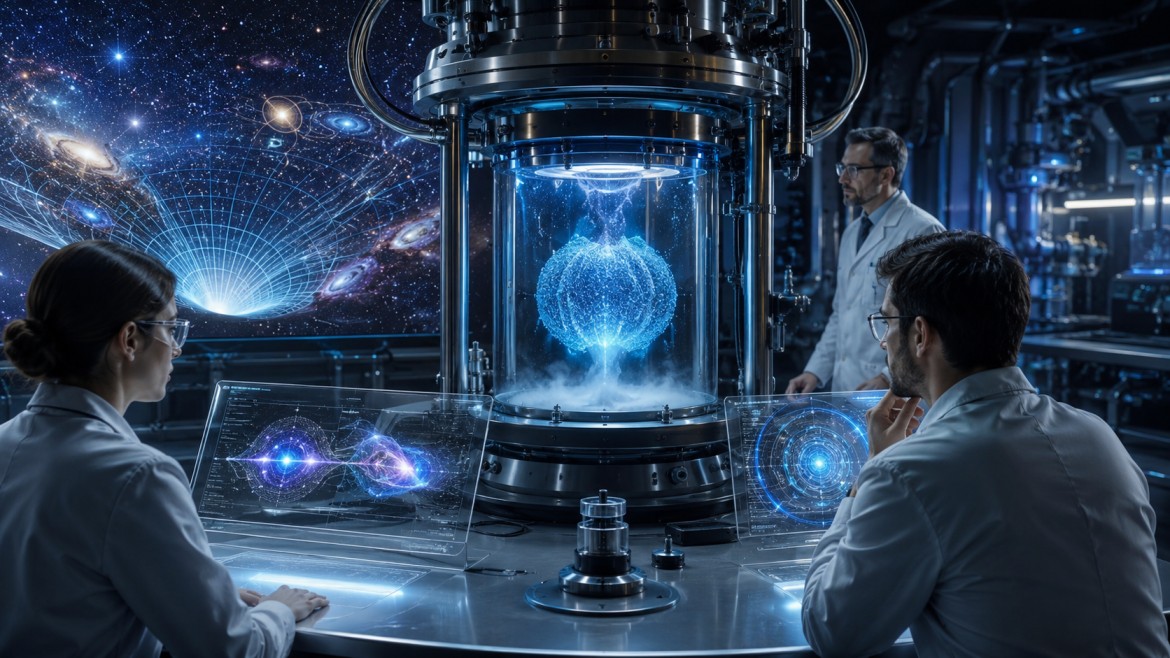
In a groundbreaking development that could reshape our understanding of the universe, physicists have successfully created an experimental "mini universe" using an exotic state of matter known as a Bose-Einstein Condensate (BEC). The innovative experiment has enabled researchers to study one of the most profound questions in modern physics—how time itself may emerge from the fundamental laws of nature.
The research represents a significant step forward in the field of quantum physics and cosmology, offering scientists an unprecedented opportunity to recreate and observe conditions that resemble those believed to have existed during the earliest moments of the universe. Rather than attempting to observe these phenomena directly in deep space, researchers have recreated key aspects of the early universe within a highly controlled laboratory environment.
A Bose-Einstein Condensate is an unusual state of matter that forms when certain atoms are cooled to temperatures only a fraction above absolute zero. Under these extreme conditions, individual atoms lose their separate identities and begin behaving as a single quantum entity. Because of its unique quantum properties, BEC has become one of the most valuable experimental platforms for simulating complex physical systems that cannot be studied directly.
Using this quantum medium, scientists designed what they describe as a laboratory-scale "mini universe" capable of reproducing some of the mathematical and physical characteristics associated with the early cosmos. Their primary objective was to investigate the "Emergence of Time"—the idea that time may not be a fundamental feature of reality but instead arise from deeper quantum interactions.
This concept has gained increasing attention among theoretical physicists over the past several decades. While everyday experience treats time as a constant flow moving from past to future, several leading theories of quantum gravity suggest that time might not exist in the conventional sense at the most fundamental level of the universe. Instead, it could emerge from the relationships between quantum particles and fields.
The laboratory experiment allowed researchers to observe how quantum systems evolve under carefully controlled conditions. The findings suggest that certain collective quantum behaviors can mimic the development of temporal order, providing valuable clues about how time might have appeared as the universe evolved after the Big Bang.
Although the experimental model does not recreate the entire universe, scientists emphasize that it serves as a powerful analogue system for testing theoretical predictions that would otherwise remain impossible to verify. Such analogue experiments have become increasingly important in modern physics because many extreme cosmic environments—including those near black holes or during the universe's earliest fractions of a second—cannot be reproduced directly.
Experts believe the study could contribute significantly to ongoing efforts to develop a unified theory that combines Einstein's General Theory of Relativity, which explains gravity on cosmic scales, with Quantum Mechanics, which governs the microscopic world. Reconciling these two foundational theories remains one of the greatest unsolved challenges in physics.
Beyond its theoretical importance, the research also demonstrates the growing capability of quantum technologies. Bose-Einstein Condensates have already found applications in ultra-precise measurements, quantum sensing, and next-generation atomic clocks. Their use as experimental models for cosmology highlights the expanding role of quantum laboratories in exploring questions that were once considered purely philosophical.
Scientists caution that further experimental validation and theoretical refinement will be required before definitive conclusions can be drawn about the true nature of time. Nevertheless, the success of this "mini universe" experiment provides an exciting new framework for investigating some of the deepest mysteries of existence, including the origin of space-time, the evolution of the early universe, and the fundamental structure of reality itself.
As research continues, experiments involving Bose-Einstein Condensates and other quantum systems are expected to play an increasingly important role in advancing our understanding of the cosmos. If future studies confirm these findings, they could fundamentally transform our understanding of time—not merely as a quantity measured by clocks, but as an emergent property arising from the quantum fabric of the universe.
The achievement underscores the remarkable progress being made in experimental physics and reinforces the growing synergy between laboratory-based quantum research and modern cosmology. By creating a controllable "mini universe," scientists have opened a new window into questions that have fascinated humanity for centuries, bringing researchers one step closer to understanding how the universe—and time itself—came into existence.