Israel’s general election has produced a politically uncertain outcome, with Prime Minister Benjamin Netanyahu’s Likud party emerging as the largest single party but his right-wing alliance falling short of a parliamentary majority. The final results have opened the door to intense coalition negotiations, strengthened the position of Arab-led parties and raised questions about Netanyahu’s political future. Neither the ruling bloc nor the main opposition has secured the 61 seats required to command a majority in Israel’s 120-member parliament, known as the Knesset.
Netanyahu’s Likud Remains the Largest Party
According to the final vote count published by Israel’s Central Elections Committee, Likud won 27 seats, while the opposition’s Yashar party, led by former military chief Gadi Eisenkot, secured 21 seats. B’Yachad won 12 seats, while the Joint List obtained 11. The Democrats and the Arab-led Ra’am party secured eight seats each. Yisrael Beytenu, United Torah Judaism and Otzma Yehudit won seven seats apiece, while Shas and Religious Zionism secured six seats each.
At the bloc level, Netanyahu’s right-wing and religious allies secured 53 seats, compared with 48 for the main opposition bloc. Arab-led parties won the remaining 19 seats, marking a historic electoral performance. Turnout reached 77.9 per cent, with approximately 5.72 million votes cast.
Although Likud remains Israel’s largest individual political party, Netanyahu’s alliance has lost the parliamentary majority it previously enjoyed. His bloc had controlled as many as 68 seats in the outgoing parliament, making the latest result a significant setback for the prime minister and his allies. The final seat distribution means that neither major political camp can form a government independently without securing additional support.
What Did Netanyahu Say After the Election?
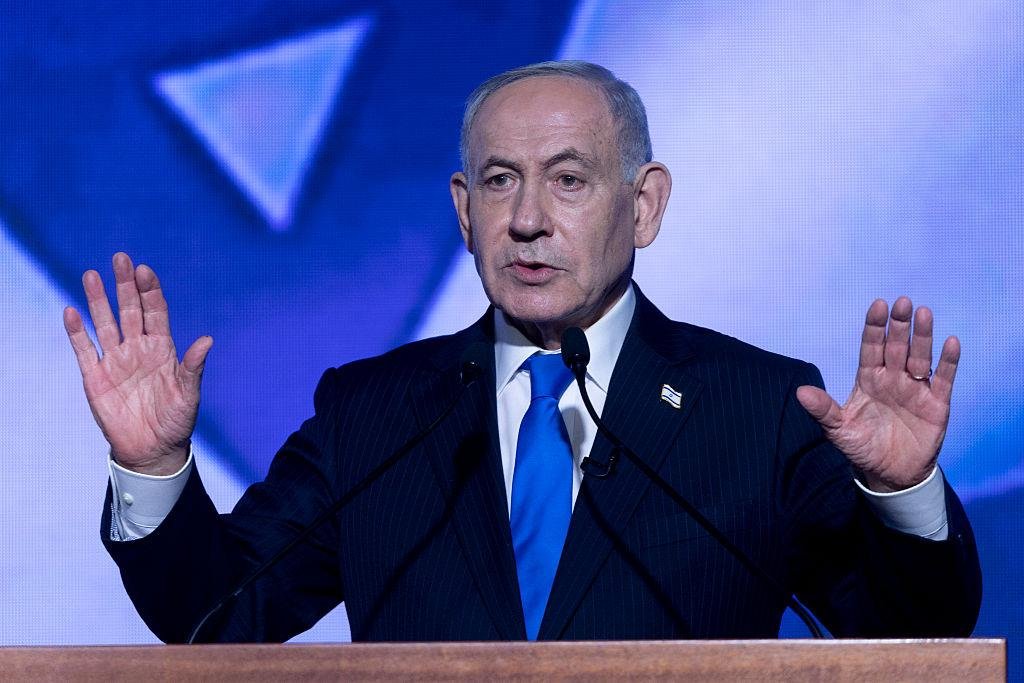
Netanyahu responded to the emerging results by highlighting Likud’s position as Israel’s largest party and insisting that the right-wing camp retained substantial support among Jewish and Zionist voters. Addressing supporters at the party’s election headquarters in Jerusalem, he argued that Israel needed a strong, nationalist government and rejected the prospect of a coalition dependent on Arab-led parties.
Netanyahu also presented the election in the context of Israel’s national security challenges, particularly its confrontation with Iran. He said Israel was stronger than ever and described the country as having a historic opportunity, alongside US President Donald Trump, to eliminate the Iranian threat. However, his confidence in Likud’s individual performance contrasted with the parliamentary arithmetic: the right-wing bloc remained eight seats short of the 61-seat majority.
Following the election, Netanyahu and Likud also alleged that Arab-led parties had manipulated the electoral process and claimed that the election had been stolen. The allegations included claims of bribery, intimidation and possible foreign interference. These accusations have not been established as fact. Israel’s election authorities and police rejected claims of widespread electoral fraud as unsupported, while the Shin Bet security agency clarified that its investigation into suspected foreign interference was limited in scope and did not cast suspicion on Arab voters as a whole.
The allegations have intensified political tensions, with opposition figures accusing Netanyahu of attempting to undermine the legitimacy of the results. Qatar, which was mentioned in allegations of foreign involvement, denied interfering in the election. The investigation remains a separate matter from the completed vote count and does not, by itself, invalidate the results.
Arab Parties Emerge as Potential Kingmakers
One of the most consequential developments in the election is the unprecedented combined representation secured by Arab-led political parties. The Joint List won 11 seats, while Ra’am obtained eight, giving them a combined total of 19 seats in the Knesset.
Their performance could prove decisive in determining who forms the next government. The main opposition bloc, led by Eisenkot, has 48 seats. If it secures sufficient support from Arab-led parties and other lawmakers, it could potentially reach the 61-seat threshold needed for a parliamentary majority.
However, such an arrangement faces significant political obstacles. Netanyahu has strongly opposed a government dependent on Arab-led parties, while some opposition politicians have also expressed reservations about entering a formal coalition with them. This leaves Eisenkot facing a difficult choice between seeking parliamentary support from Arab parties, negotiating a broader national unity arrangement or attempting another political combination.
Arab-led parties could also influence parliamentary leadership, legislative priorities and negotiations without necessarily joining the government. Their record electoral showing has therefore given them greater bargaining power at a critical moment in Israeli politics.
What Happens Next?
The next phase will be dominated by negotiations between political parties seeking to assemble a viable government. Israel’s President Isaac Herzog is expected to receive the certified results on November 4 and consult party leaders before deciding whom to invite to form a government. The new Knesset is scheduled to be sworn in on November 10.
Netanyahu could still attempt to form a government by persuading additional lawmakers or parties to join his camp. Another possibility is a national unity government involving political forces from opposing camps, although ideological differences and disagreements over leadership could make such an arrangement difficult.
Alternatively, Eisenkot could attempt to build an opposition-led coalition with support from Arab-led parties. This route would require political compromises and a willingness among participating parties to overcome their differences on national security, relations with Palestinian citizens of Israel and other sensitive issues.
If the parties fail to reach an agreement, Israel could face another election early next year. Netanyahu would remain in office in a caretaker capacity until a new government is formed. The prospect of another election would prolong political uncertainty at a time when Israel continues to face major security and diplomatic challenges.
Implications for the Middle East
The election outcome could have important implications for Israel’s policies towards Iran, the Palestinians, Gaza and neighbouring Arab countries. Netanyahu has consistently emphasised military strength and a hard-line approach towards Iran. A government led by him would likely continue to place national security and regional deterrence at the centre of its agenda, although the precise policy direction would depend on the composition of any coalition.
An opposition-led government could seek a different balance between security priorities, diplomacy and domestic political reform. Nevertheless, a change in leadership would not automatically produce a major shift in Israel’s policies towards Iran or the Palestinian territories, where security concerns and deep political divisions remain influential.
The strong performance of Arab-led parties could also bring greater attention to the political representation and domestic concerns of Israel’s Arab citizens. At the same time, the controversy surrounding allegations of electoral interference risks deepening divisions between Jewish and Arab communities if unsubstantiated accusations continue to circulate.
For the United States and other regional powers, the immediate priority will be to assess whether Israel can establish a stable government capable of making consistent decisions on security and diplomacy. Prolonged coalition negotiations could complicate decision-making on Iran, Gaza and wider Middle Eastern security arrangements.
Conclusion: A Setback for Netanyahu, but Not the End of His Political Career
Israel’s election has delivered a complicated verdict rather than a decisive transfer of power. Netanyahu’s Likud remains the largest party, but his alliance’s 53 seats leave him without a parliamentary majority. Meanwhile, Eisenkot’s opposition bloc and the 19 lawmakers from Arab-led parties have gained greater leverage over the formation of the next government.
The immediate battle will be fought through coalition negotiations rather than another round of voting. Netanyahu still has a path to political survival, but it will require difficult compromises. The opposition, meanwhile, must demonstrate that its combined support can translate into a workable governing arrangement.