The assignment was on environmental law. The student had submitted twelve pages — well-structured, well-cited, fluid in argument. The professor at a mid-tier Australian university read it twice. Something felt wrong, but nothing was provably wrong. She ran it through Turnitin's AI detection tool. The software returned a score of 22%. Not high enough to act on. Not low enough to ignore.
She failed the student anyway, trusting instinct over algorithm. The student appealed. A formal review was convened. Three weeks later, the finding came back: the professor had no grounds. There was insufficient evidence of AI use. The student passed.
This story — a version of which is now being repeated in universities on every continent — has no villain. It has only a problem that arrived before anyone built the tools to address it.
By the Numbers: A Crisis Hiding in Plain Sight
The data published in the past twelve months does not leave much room for interpretation.
According to the Higher Education Policy Institute (HEPI) Student Generative AI Survey 2025 — the most comprehensive study of its kind, covering 1,041 full-time UK undergraduates — 92% of students now use AI in some form in their studies, up from 66% in 2024. More significantly, 88% have used generative AI tools to complete assessed work — work that counts toward their degrees — up from 53% the year before.
Those are not outliers. The Digital Education Council's Global AI Student Survey 2024, covering 3,839 students across 16 countries, found 86% of students globally use AI tools in their studies. In Australia, nearly 80% of university students report using AI. In the United States, RAND's American Youth Panel — a nationally representative survey of more than 1,000 students, conducted in December 2025 — found that between May and December 2025 alone, the share of students using AI for homework rose from 48% to 62%, driven largely by middle and high school students.
The pipeline feeding universities is already saturated.
Turnitin, which has scanned over 200 million academic papers since April 2023, found that 10.3% contained at least 20% AI-generated text, and 3% were predominantly AI-written — essentially unedited output submitted as original student work. In the UK, nearly 7,000 students were formally caught cheating with AI in the 2023–24 academic year — triple the number from the previous year, and part of a nearly 400% increase in AI-related misconduct cases over just three academic years.
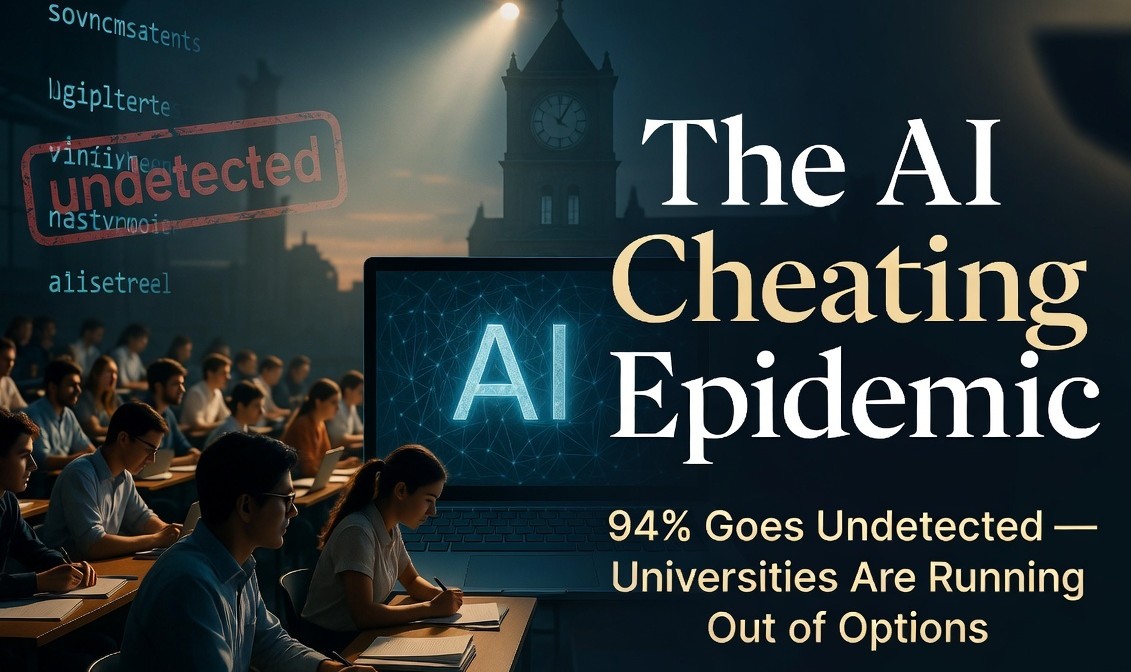
And yet: despite a 33% increase in student disciplinary action for AI misconduct between 2022 and 2026, 94% of AI-generated assignments still go undetected, according to analysis by AllAboutAI. AI misconduct cases rose from 1.6 per 1,000 students in 2022–23 to 7.5 per 1,000 in 2024–25, per the Anara 2025 higher education report. The cases being caught are a fraction of the actual volume.
The Exam That Proved Human Detection Is Broken
In the most revealing study of the past two years, researchers at the University of Reading created fake student accounts, downloaded examination questions during a live psychology degree assessment, and submitted responses generated by copy-pasting directly from ChatGPT — without any editing, improvement, or even proofreading.
94% of those submissions went completely undetected by human markers. The AI-written papers not only passed — several received grades in the upper range.
"Clever students who would cheat a little would do even better." — Etienne Roesch, University of Reading
The study demonstrated that even the lowest-quality AI output — unmodified, cut-and-pasted — beats the detection capabilities of experienced university examiners in live conditions. The response of institutions to this finding has been, largely, to pretend it did not happen.
The Detection Software That Cannot Be Trusted — And Is Being Trusted Anyway
Turnitin — the world's dominant plagiarism and AI detection platform — claims 98% accuracy for its AI detection tool. Independent testing tells a different story. Real-world detection rates on edited or paraphrased AI text drop to the 60–85% range in peer-reviewed testing. A Washington Post investigation found false positive rates as high as 50% in its test sample.
The bias problem is the most troubling dimension. A landmark Stanford University study (Liang et al.) tested seven major AI detection tools against essays written by non-native English speakers. The finding was stark: detectors misclassified 61.3% of non-native English essays as AI-generated, compared with near-zero rates for native English writing. A separate 2025 review found that up to 32% of non-native English essays were misclassified by various detectors.
Compounding this, definitions of 'cheating' vary significantly across cultures and institutions — in many academic traditions, collaborative drafting and iterative peer assistance are normal scholarly practice, making the line between legitimate help and impermissible substitution genuinely ambiguous for students navigating different systems. For Indian and Chinese students studying at Western universities, this ambiguity compounds the language-bias risk: they face a higher statistical likelihood of being wrongly flagged precisely because their careful, structured English prose most closely resembles the patterns AI detectors are trained to catch.
The consequence is real. Millions of international students face systematically elevated false-accusation risks. Vanderbilt University calculated that even a 1% false positive rate applied to 75,000 annual submissions would generate 750 wrongful accusations per year — and disabled Turnitin's AI detection entirely. Curtin University in Australia followed from January 1, 2026. UCLA declined to adopt the tool. Even OpenAI shuttered its own AI detector after it correctly identified only 26% of AI-written text while falsely flagging 9% of human writing.
"Only 28% of AI-specific plagiarism policies are deemed effective by educators." — AllAboutAI, 2025 institutional survey
When Professional Credentials Collapse
The crisis is not limited to degree programmes. It is now reaching the professional certification bodies whose qualifications define entire industries.
In December 2025, the Association of Chartered Certified Accountants (ACCA) — one of the world's largest professional accounting bodies, with 257,900 members and over 500,000 students in more than 180 countries — announced it would end remote examinations from March 2026. Internal investigations had revealed that students were using AI tools to generate exam answers in real time, undetectable by standard proctoring software. Cheating had spread to major auditing firms, including members of the Big Four.
Half a million accounting students now sit exams in person. The online option is gone. When credentials can be obtained through AI assistance that goes undetected, they stop being credentials.
The Student's Interior World
It would be easy to read these numbers as evidence of a generation's moral failure. The data suggests something more complicated.
In the same HEPI survey that found 88% of students using AI for assessed work, 59% said they worry AI could reduce their critical thinking skills. 49% are concerned about becoming too dependent on AI tools. Among RAND's US sample, 67% of students using AI for schoolwork endorsed the statement that it harms critical thinking — and used it anyway.
A BestColleges survey found that 51% of students believe using ChatGPT constitutes cheating — and 22% admit they still do it. Only 35% of students report receiving any formal institutional support to develop AI skills. The majority are learning through trial and error — which increases both the risk of misuse and the risk of false accusation.
These are not students who are unaware that something is wrong. They are students making rational choices inside a system that has not yet decided what the rules are.
What the World Is Learning — Slowly
The institutions handling this best are those that stopped trying to win an arms race and started redesigning what they are assessing.
The universities seeing the lowest rates of problematic AI use share a common characteristic: they have moved away from assessments that AI can simply answer. They ask students to defend their work in person, require process documentation — drafts, research journals, evidence of revision — and commission fieldwork and primary interviews that require lived experience no AI can replicate.
Several promising models are emerging. The UC Irvine School of Education launched a 10-week faculty retraining programme specifically teaching how to redesign assignments that critically incorporate AI rather than simply banning it — shifting the frame from 'AI as threat' to 'AI as pedagogical scaffold.' In Tennessee's Sumner County Schools, AI use is not merely permitted but expected: students are assessed on how well they interrogate and improve AI output, not on whether they used it. Harvard's generative AI policy — which permits AI for idea generation with disclosure and instructor approval — reduced AI-related violations by 30% in pilot programmes by removing the ambiguity that drives covert use.
The HEPI survey found that the proportion of students saying university staff are well-equipped to work with AI doubled in twelve months, from 18% in 2024 to 42% in 2025. Progress is real. It is also insufficient. 58% of students still do not believe their institutions are ready for the world they are already living in.
India: A Nation-Sized Version of the Same Problem
India's version of this crisis carries the particular weight of scale. The country has over 1,000 universities, 40,000 colleges, and 43 million enrolled students.
The University Grants Commission's Anti-Plagiarism Regulations were written in 2018 — before generative AI existed as a consumer product. They do not mention AI. They do not define AI-generated content. As of 2025, the UGC has issued no formal amendment to these regulations. However, in February 2026, the UGC enforced its existing 2018 framework in a high-profile action: dozens of PhD theses at a state university were rejected after exceeding 40% AI-generated content similarity — with students found to have submitted unattributed ChatGPT output as original research. The UGC's position is now explicit: unacknowledged AI-generated content constitutes plagiarism under the existing 2018 framework. A formal AI-specific policy update, however, has not yet arrived.
A Pune university study found 30% of students admitted to using ChatGPT to complete assignments. In Gujarat, two BCA students were caught reading AI-generated answers from smartwatches during a live examination — the first documented case of smartwatch-based AI cheating in the state. They were fined ₹5,000 each.
Sixty percent of higher education leaders globally say cheating has increased since generative AI became widespread. Fifty-four percent say their faculty are not effective at recognising AI-generated content. If institutional executives are this uncertain, the reality on the ground is worse.
What Needs to Change
Globally, the arms race between AI and AI detection is one that detection will never win. Times Higher Education confirmed this: by prompting ChatGPT to 'write like a teenager', researchers reduced Turnitin's detection rate from 100% to 0% in a single session.
The assessment itself must change. Oral examination, portfolio assessment, process documentation, and project-based work requiring human presence are not innovations. They are the oldest forms of academic verification in existence. Universities abandoned them in favour of scalable written assessments. The AI crisis is, among other things, an invoice for that decision.
The students know this. In survey after survey, they report using AI while worrying about what it is doing to their ability to think. They are asking — implicitly, through their behaviour — for institutions to redesign what learning means. That is not a crisis. That is an opportunity. Whether universities choose to see it that way is the only question left.